I Ching Hexagram 17, Following: The Art of Right Allegiance
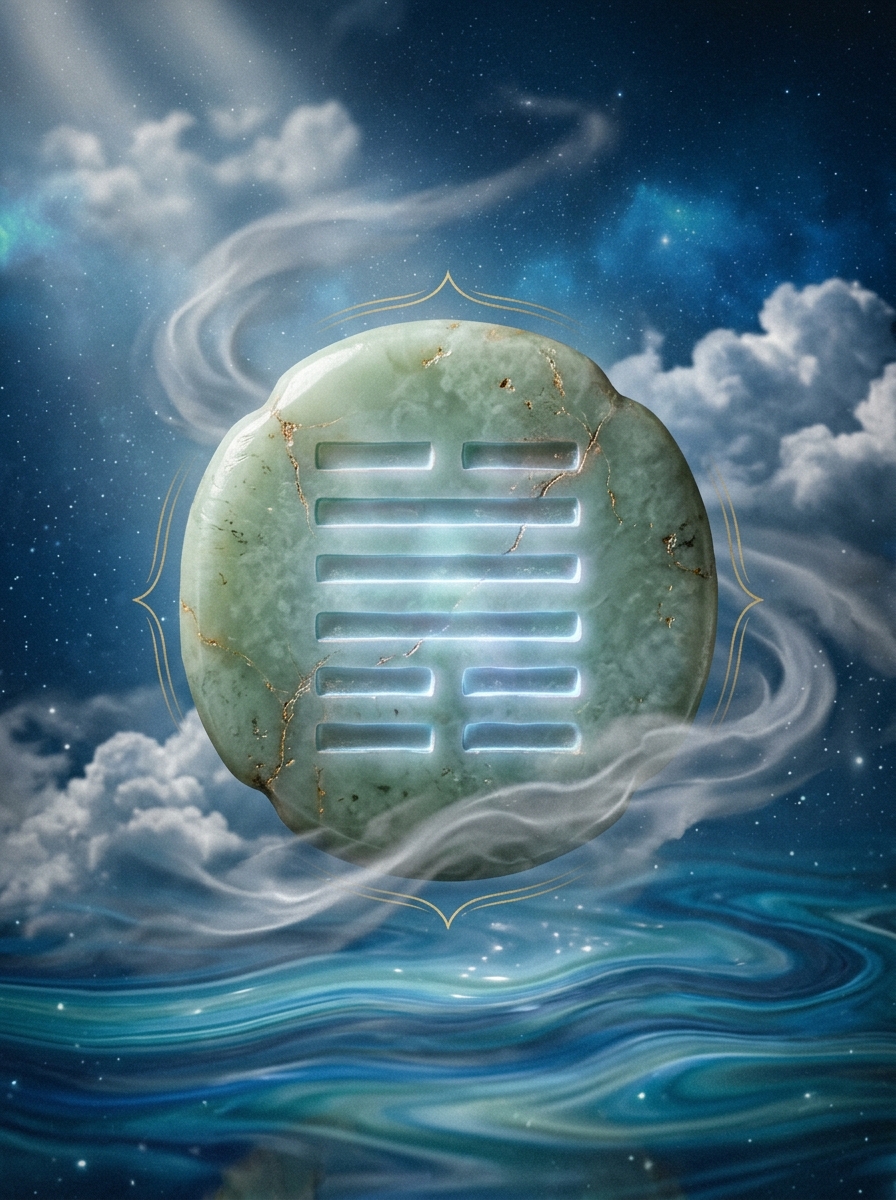
I Ching Hexagram 17: Following
Following is not obedience—it is the discipline of choosing what deserves your consent. The hexagram’s thesis is severe: life opens when the self stops trying to dominate every current and learns the difference between surrender and submission. In the I Ching, that difference is everything.
The Image: Thunder Beneath the Lake
Following is formed by Lake above Thunder: the yielding upper trigram resting on the arousing lower one. Thunder does not crash overhead; it stirs beneath the surface, as if a hidden force were moving under calm water. That tension is the hexagram’s first lesson. What follows is not passive drift but responsive movement organized around a living impulse.
The old commentaries read this as a noble person adapting to a leader, but the deeper psychological picture is more exacting. Thunder below suggests instinct, urgency, initiation; Lake above suggests fluidity, pleasure, social ease, the capacity to receive. When paired, the psyche is asked to let the active force operate without turning it into egoic control. The outer self becomes receptive enough to recognize the right direction; the inner energy becomes strong enough to move without forcing the issue.
This is why Hexagram 17 is not about passivity. It is about attunement. The right kind of following is alert, selective, alive. It notices where energy is already going and joins it without hypocrisy. In human terms, that might mean recognizing a mentor worth trusting, a relationship that asks for real reciprocity, or a call that has already begun to gather momentum inside you. The hexagram’s wisdom is that will is most effective when it aligns with what is already unfolding.
The Judgment: Allegiance That Creates Order
The judgment of Following is notoriously concise, and its brevity is part of its force. Traditional translations vary, but the central meaning is consistent: Following brings success; it is favorable to perseverance; no blame. The line “at midwinter” in some renderings hints at timing and containment: you do not force spring in winter. You prepare, wait, and respond when the right pattern emerges.
This makes Hexagram 17 one of the I Ching’s clearest teachings on lawful movement. The question is not whether to yield, but what kind of structure your yielding serves. The judgment implies that allegiance is fruitful when anchored in correctness, not fear. If the object of your following is genuine, support arrives with unusual ease. If the object is corrupt, the same capacity to follow becomes dangerous, because the soul can be led by charisma, appetite, or social pressure instead of truth.
That is why the phrase “no blame” matters. It does not excuse irresponsibility; it indicates that the act of following, when properly chosen, carries no moral remainder. You are not compromising yourself by joining the right current. In fact, refusing to recognize rightful authority can become a subtler form of vanity than blind obedience. Following asks you to audit your motives. Are you resisting because your pride wants to remain sovereign, or are you withholding consent because the thing in front of you is actually false?
Why Timing Is Part of the Meaning
The I Ching treats timing as ethical. In Hexagram 17, timing is crucial because following must occur when the path has already taken shape enough to be read. A wise person does not impose movement where the field is not yet ready. Nor does they cling to an old self-image after the situation has clearly changed. The hexagram favors responsiveness over self-assertion, but not indecision. It praises those who can sense when to enter, when to support, and when to let a larger pattern lead.
This is especially relevant in periods of transition. If a job, relationship, or vocation has entered a phase where you can no longer command the outcome, Following asks whether you can align with the real terms of the moment instead of the fantasy of control. The reward is not compliance itself; it is participation in a pattern that can actually hold your life.
The Shadow: When Following Becomes Self-Erasure
The shadow side of Following is loss of discernment. If you have spent years over-controlling everything, the hexagram may feel like relief. But if you have already been over-adapted, it can intensify a chronic habit of self-abandonment. In psychological terms, the danger is that the ego mistakes submission for belonging. Jung would recognize this as a problem of projection: you locate authority outside yourself because you have not yet learned to inhabit your own center.
That is why this hexagram demands moral discrimination. It is not enough to be cooperative. The question is whether your cooperation is coherent with your deeper values. If it is, support will feel strangely spacious, almost clean. If it is not, resentment will accumulate. The body often knows first: tension, fatigue, hesitation, a subtle loss of vitality. Following asks you to notice those signals before you call them loyalty.
When Attunement Turns into Drift
In practice, the shadow often shows up as social imitation. You may be following trend, mood, family expectation, or the strongest personality in the room and calling it flexibility. In that case, the hexagram is not flattering you—it is diagnosing you. True following should reduce confusion, not deepen it. It should make action simpler, not smaller. If your allegiance leaves you feeling more fragmented or more tired, you are likely in the shadow pattern.
The cure is not to stop following but to sharpen your criteria. Hexagram 17 trains the ability to read character quickly. Observe who increases clarity, who distorts it, and who leaves you more fully yourself after contact. That is the discernment the hexagram demands.
How It Plays Out in a Life
Following does not have separate “meanings” for love, work, and spirit—it has the same dynamic expressed in different domains. In relationships, it asks whether you are choosing partners who deserve your trust or merely conforming to the person who wants you most. In career, it asks whether your loyalty to a boss, company, or vocation is anchored in true alignment or in fear of striking out alone. In creativity, it asks whether you are apprenticing yourself to the craft itself rather than to its applause.
The key divinatory question is never merely “Who should I follow?” but “What principle, person, or process is trustworthy enough to deserve my allegiance?” The answer can be external or internal. Sometimes the appropriate leader is another human being who has earned your respect through competence and integrity. Sometimes it is the slower intelligence of your own body, which already knows that your old pace is unsustainable. Sometimes it is the work itself, which calls for humility before craft. Following is successful when it is in service to something real.
When It Turns Upward
One of the subtler teachings of Following is that it can become leadership by example. The person who has practiced disciplined receptivity may eventually hold authority without coercion. The power to follow correctly often precedes the power to lead well. A good guide has usually been a good student first.
This is why the hexagram does not end in dependency. It is a form of training in right relationship to authority, not a permanent loss of agency. If the reading is favorable, your capacity to discern worthy influence is maturing. If it is difficult, your work may be to stop chasing noisy charisma and begin respecting the quieter forms of truth.
Inner Meaning: The Soul’s Consent
At its deepest level, Following concerns the soul’s consent to reality. Not resignation, not defeat, but consent: the clear-eyed decision to cooperate with what is genuinely there. That interrupts the fantasy that freedom means unbounded self-assertion. The I Ching keeps reminding us that freedom often begins where resistance to reality ends.
In this sense, Hexagram 17 is a corrective to modern myths of authenticity that equate selfhood with constant originality. Sometimes authenticity means recognizing your place in a larger pattern and taking it seriously. The lake does not apologize for reflecting the sky; thunder does not apologize for moving. Each fulfills its nature by participating in relation. Likewise, human beings become more themselves when they follow what is true rather than what is merely personal.
If you receive this hexagram, do not rush to declare yourself passive or submissive. Ask instead what is worthy of your trust, where your energy is already gathering, and what structure could hold your life without distorting it. Following is the art of joining the right current with your eyes open. That is not less than freedom. It is freedom, made real.
Comments
Loading comments…